
You have received a letter, records request, or questions from the EDD and are uncertain about how your business should respond.
- The EDD has requested payroll, worker, financial, or other business records.
- You are unsure which records are responsive to what the EDD is asking for.
- You have been asked questions about workers, compensation, payroll practices, or how your business operates.
- You are concerned that an informal explanation could be misunderstood or taken out of context.
- You want to respond appropriately without providing incomplete, inaccurate, or poorly explained information.
Learn More →

The EDD is examining whether people your business treated as independent contractors or otherwise classified outside of payroll should have been treated differently.
- The EDD is asking about workers who received 1099s rather than W-2s.
- The auditor wants information about what particular workers did and how they performed their work.
- You are being asked about compensation, supervision, schedules, responsibilities, or the business relationship with particular workers.
- Worker classification has become a central issue in an audit that initially appeared to concern payroll or records.
- You are concerned that a different classification could create payroll tax exposure for prior periods.
Learn More →

The auditor appears to be developing a view of your workers, payments, relationships, or business operations that does not reflect how your business actually operated.
- The EDD appears to be drawing conclusions from records without the context needed to understand them.
- The auditor's description of a worker's role does not match the work that person actually performed.
- Payments or reimbursements are being interpreted differently from how they occurred within the business.
- Important facts about particular workers or business relationships do not appear to be reflected in the EDD's position.
- You are concerned that assumptions made during the audit could become the basis for an inaccurate determination.
Learn More →

You are trying to determine whether you can continue handling the EDD matter internally or whether the circumstances now warrant experienced legal representation.
- The EDD is asking questions you are no longer comfortable answering without guidance.
- Worker classification, payroll reporting, withholding, or other disputed issues have become part of the investigation.
- The amount of information being requested or the number of periods being examined has increased.
- You believe the EDD may be developing conclusions that could create meaningful financial exposure for the business.
- You are facing decisions about how to respond, what position to take, or whether an EDD finding should be challenged.
Learn More →

You understand that the EDD matter may require professional representation, but you want to know what an experienced EDD tax attorney can actually do for your business.
- You want someone to manage or guide communications with the EDD.
- You need help reviewing document requests and determining how requested information should be organized and presented.
- Worker classification or other payroll tax issues require analysis before the business takes a position.
- You need the factual record evaluated against assumptions or conclusions being made by the EDD.
- You are concerned that the audit may involve legal, tax, accounting, and business issues that need to be considered together.
Learn More →

What initially appeared to be a limited EDD inquiry is expanding into a broader or more consequential examination of your business.
- The EDD is requesting additional categories of records or information.
- More workers or worker classifications are being questioned.
- The audit has expanded to additional tax periods or payroll practices.
- The questions being asked suggest that potential assessments or other financial consequences may be increasing.
- What began as a manageable records request now appears to involve several interconnected issues affecting the business.
Learn More →

You are already involved in an EDD audit or investigation and want to understand how the process may develop from here.
- The EDD is gathering records, asking questions, and examining information about your business.
- The auditor may be focusing on particular workers, payments, payroll practices, or reporting issues.
- You are being asked for additional information as the EDD develops its understanding of the business.
- You want to know how the EDD moves from gathering information to reaching findings or determining whether amounts may be owed.
- You want to understand what decisions the business may face once the EDD communicates its conclusions.
Learn More →

The EDD has reached or appears to be moving toward a finding or assessment that your business believes may be incorrect.
- You disagree with how the EDD has interpreted important facts about your business.
- The EDD's conclusions about particular workers, payments, or payroll practices do not reflect your understanding of what occurred.
- A proposed assessment or other adverse result may create significant financial consequences for the business.
- You have records, explanations, or other information that you believe should be considered before the result becomes final.
- You need to understand whether and how the EDD's findings can be challenged and what information will matter in doing so.
Learn More →

I Am Not Sure What I Should Say or Provide to the EDD
Communications With the EDD • Document Requests • Developing an Accurate Record
An EDD audit or investigation may begin with what appears to be a straightforward letter, request for records, or series of questions. The difficulty is that a business owner may not yet understand what the EDD is examining, what conclusions the auditor may be developing, or how the information being requested fits into the larger investigation.
The objective is not to avoid legitimate EDD requests. It is to respond accurately, appropriately, and with an understanding of what is being asked and why the information matters.
Understand the Request Before You Respond
A request for payroll records, worker information, compensation records, reimbursements, contracts, or other business documents should be evaluated in the context of the audit.
The same is true of questions from an auditor. A business owner may know exactly how the company operates yet provide an informal explanation that is incomplete because the owner does not realize which facts are important to the issue the EDD is examining.
This is the primary reason Janathan Allen evaluates the request, the records available, the underlying business circumstances, and the issues developing within the audit before determining how the business should respond.
Your Records and Your Explanation Should Tell the Same Accurate Story
Documents do not always explain themselves.
Payroll records, 1099s, agreements, invoices, reimbursements, accounting records, and other business documents may show individual transactions without explaining the relationships or circumstances behind them. When necessary context is missing, an auditor may develop an understanding that differs from what actually occurred.
The goal is to develop an accurate and organized factual record. That includes understanding what information the EDD has requested, identifying the records that respond to the request, and determining whether additional context is necessary to accurately explain the business and its practices.
Early Communications Can Affect What Happens Later
What is communicated and provided during the early stages of an EDD matter may influence the questions the auditor asks next, the issues the EDD examines, and the factual positions that develop during the audit.
That does not mean every EDD contact should be treated as an adversarial event. It means communications and document production should be deliberate rather than improvised.
Allen Barron can help manage communications with the EDD, review document requests and proposed responses, understand the underlying tax and business issues, and help ensure that the business's position is developed from the actual facts and available records.
Next Action Step
If you have received an EDD letter, records request, or questions and are uncertain about how your business should respond, this is an appropriate time to understand what the EDD is examining and what information is available before making consequential decisions.
We invite you to a complimentary and substantive conversation regarding your situation, objectives, and concerns. You can reach out through the chat module on this page, our contact form, or by calling 866-631-3470.
The EDD Is Questioning How We Classified Our Workers
Worker Classification • Actual Working Relationships • Payroll Tax Exposure
Worker classification questions can quickly become one of the central issues in an EDD audit. The EDD may be examining workers the business treated as independent contractors, people who received 1099s, or other working relationships that the agency believes should have been handled differently.
At that point, the issue is no longer simply how the business labeled a worker. It becomes necessary to understand the actual relationship between the worker and the business and the records and facts that support the company's position.
Start With How the Relationship Actually Worked
Worker classification should be evaluated from the actual circumstances rather than assumptions based only upon a job title, payment method, contract, or 1099.
What work did the person perform? How did the relationship operate? How was the worker compensated? What responsibilities did the worker and the business actually have? What agreements, records, communications, invoices, or other information document the relationship?
Developing that factual picture allows Janathan Allen and Allen Barron to understand the position the EDD is taking and compare it with what actually occurred within the business.
Understand the Potential Scope of the Classification Issue
A classification question involving one worker or group of workers may affect more than a single payment or tax period. The EDD may examine payroll reporting, withholding, compensation, unemployment insurance, employment training tax, state disability insurance, and other payroll-related practices.
The important first step is to determine what the EDD is actually questioning, which workers and periods are involved, and what potential exposure may result if the agency disagrees with the company's classification.
Build the Position From the Facts and Records
Allen Barron's role is to help evaluate the worker relationships, organize the relevant factual record, understand the tax implications, and develop the business's position based upon the available evidence.
Allen Barron's integrated legal, tax, accounting, and business capabilities can be particularly valuable when a classification dispute reaches across several aspects of the company's operations and financial records.
Next Action Step
If the EDD is questioning workers your business classified as independent contractors or otherwise challenging your payroll practices, understanding the actual relationships and the available documentation should come before deciding how the business will respond.
We invite you to a complimentary and substantive conversation regarding your situation, objectives, and concerns. You can reach out through the chat module on this page, our contact form, or by calling 866-631-3470.
The EDD's View of Our Business Does Not Match What Actually Happened
Auditor Assumptions • Business Reality • Developing the Factual Record
One of the most difficult points in an EDD audit occurs when the business realizes that the auditor is developing conclusions that do not accurately reflect how the company, its workers, or particular transactions actually operated.
This is different from simply deciding what to say to the EDD. The problem is now substantive: the factual picture developing within the audit may be wrong or incomplete.
Identify Where the EDD's Understanding and the Facts Diverge
The first task is to determine precisely where the disagreement exists.
The issue may involve what a worker actually did, how a relationship operated, why particular payments were made, how compensation or reimbursements were handled, or what business records actually represent.
A generalized statement that "the auditor has it wrong" is rarely enough. The stronger approach is to identify the specific factual assumptions in question and determine what records, communications, financial information, agreements, or other evidence can establish what actually happened.
Develop the Record Instead of Arguing From Conclusions
A productive response begins with evidence.
Allen Barron can review the auditor's position, compare it with the company's records and actual business practices, identify information that may be missing or misunderstood, and help develop a coherent factual explanation.
The objective is not simply to disagree with the EDD. It is to establish why the business believes the agency's understanding is incomplete or inaccurate and support that position with the strongest available factual record.
The Factual Record May Matter Beyond the Immediate Discussion
As an audit progresses, early assumptions can influence later findings. This makes it important to identify factual disagreements while relevant information can still be assembled, explained, and evaluated.
Allen Barron's combination of legal, tax, accounting, and business experience allows the underlying records and the operational reality of the business to be considered together rather than treating the matter as an abstract tax question.
Next Action Step
If the EDD's developing view of your company does not match what actually occurred, identify the specific points of disagreement and the information available to establish the facts before simply repeating the same explanation to the auditor.
We invite you to a complimentary and substantive conversation regarding your situation, objectives, and concerns. You can reach out through the chat module on this page, our contact form, or by calling 866-631-3470.
Do I Need an Attorney if the EDD Is Investigating Us?
Complexity • Financial Exposure • When Representation Becomes Important
Not every contact from the EDD presents the same level of complexity or risk. A business owner may reasonably begin by trying to understand the request and determine whether the matter can be handled internally.
The decision changes as the issues become more consequential.
Look at What the EDD Is Actually Examining
The question is not simply whether the EDD has contacted you. The better question is what is developing within the investigation.
Is worker classification disputed? Are multiple workers or tax periods involved? Is the EDD questioning payroll reporting, compensation, withholding, or other business practices? Does the auditor appear to be developing conclusions the company believes are incorrect? Is there meaningful potential financial exposure?
As those issues accumulate, the value of experienced representation increases because decisions made during the audit may affect both the immediate matter and the options available later.
Representation Is About More Than Answering the Auditor
An experienced EDD tax attorney can help the business understand the scope of the inquiry, evaluate requested information, identify developing risks, manage communications, analyze disputed issues, and determine how the company's factual and legal position should be developed.
This becomes particularly important when a business owner or internal accounting professional realizes the matter has moved beyond ordinary record production and into disputed tax, classification, or factual issues.
Consider the Broader Business and Tax Picture
An EDD audit does not necessarily exist in isolation. Findings may raise other California or federal tax questions that should be evaluated as part of the broader situation.
Allen Barron's integrated legal, tax, accounting, and business capabilities allow the firm to evaluate not only the immediate EDD issue but also the related financial, accounting, operational, and tax considerations that may affect the company.
Next Action Step
If you are asking whether the EDD matter has reached the point where your business should have legal representation, examine the complexity of the issues, the potential exposure, the factual disagreements, and the decisions you are now being asked to make.
We invite you to a complimentary and substantive conversation regarding your situation, objectives, and concerns. You can reach out through the chat module on this page, our contact form, or by calling 866-631-3470.
How Can an Experienced EDD Tax Attorney Protect Us in an EDD Audit?
Managing the Audit • Developing Your Position • Coordinating Legal, Tax and Accounting Issues
Once a business determines that professional representation is appropriate, the next question is practical: What will an experienced EDD tax attorney actually do?
Effective representation should bring structure to the audit. The attorney should understand what the EDD is investigating, what information the agency has requested, what the records show, where the risks and disputed issues exist, and what the business needs to accomplish.
Manage Communications and Information
Allen Barron can serve as a point of guidance and representation in communications with the EDD.
This includes reviewing document requests, evaluating proposed responses, helping organize information, preparing for substantive communications with the agency, and keeping the business focused on the actual issues under examination.
The purpose is not to interfere with the audit. It is to make sure the business approaches communications and document production deliberately and from an informed position.
Identify the Issues and Develop the Business's Position
An EDD audit may involve worker classification, payroll reporting, compensation, withholding, reimbursements, or other employment tax issues.
Allen Barron can evaluate the records and business circumstances behind those questions, identify weaknesses or unsupported assumptions in the agency's developing position, and help build the factual and legal basis for the company's response.
If the EDD ultimately proposes an assessment or reaches findings the business disputes, counsel can also evaluate the result and the available options for challenging it.
Bring Legal, Tax, Accounting and Business Issues Together
EDD matters frequently involve more than one professional discipline.
A worker classification issue may have tax and accounting consequences. An audit finding may affect financial reporting or raise questions involving another taxing authority. A technically correct response may still have important operational implications for the company.
Allen Barron's integrated legal, tax, accounting, and business advisory capabilities allow these issues to be evaluated together rather than requiring the business owner to coordinate disconnected professionals while an audit is underway.
Next Action Step
The value of experienced EDD representation should be measured by what counsel actually contributes: understanding the audit, managing communications, developing the factual position, evaluating exposure, coordinating related issues, and helping the business make informed decisions as the matter progresses.
We invite you to a complimentary and substantive conversation regarding your situation, objectives, and concerns. You can reach out through the chat module on this page, our contact form, or by calling 866-631-3470.
The Investigation or Audit Is Getting More Serious Than I Expected
Expanding Scope • Increasing Exposure • Regaining Control of the Matter
An EDD matter can begin with a relatively narrow request and then change character as the audit develops.
Additional records may be requested. More workers may come under examination. Additional tax periods or payroll practices may become relevant. Questions may become more detailed, and the potential financial consequences may become clearer.
At that point, the business should reassess the matter based upon what it has become—not what it appeared to be when the first letter arrived.
Determine What Has Changed
The first step is to identify how the scope has expanded.
Has the EDD moved from one worker or classification issue to a broader group? Are additional periods being examined? Have new payroll, compensation, reimbursement, or reporting questions emerged? Is the agency requesting information that suggests it is developing a broader theory of the case?
Understanding the expansion helps identify where the greatest risks now exist and what information needs to be developed.
Evaluate the Exposure Before Making the Next Decision
As an audit becomes more complex, the potential consequences should be evaluated systematically.
That means understanding which issues are disputed, what records support the company's position, where the factual weaknesses may be, what potential assessments are developing, and whether the matter may create related California or federal tax concerns.
The purpose is not to assume the worst. It is to replace uncertainty with a clearer understanding of the actual situation.
Bring Structure Back to an Expanding Audit
When several issues are developing simultaneously, reacting to each new request independently can make it difficult to see the larger picture.
Janathan Allen and the team at Allen Barron can help organize the issues, establish the factual chronology, evaluate the records and potential exposure, manage communications with the EDD, and determine which matters require immediate attention and which should be addressed as the audit develops.
Next Action Step
If an EDD inquiry that initially appeared manageable is expanding into additional workers, records, tax periods, or potential assessments, this is an appropriate point to reevaluate the matter as a whole rather than continuing to address each new development in isolation.
We invite you to a complimentary and substantive conversation regarding your situation, objectives, and concerns. You can reach out through the chat module on this page, our contact form, or by calling 866-631-3470.
What Happens During and After an EDD Audit?
Information Gathering • Developing Findings • Important Decision Points
An EDD audit is a developing process rather than a single event. The agency gathers information, asks questions, examines records and business practices, develops its understanding of the relevant issues, and ultimately reaches findings based upon that investigation.
For a business owner, the important point is not to memorize every procedural step. It is to understand where the business is in the process, what the EDD is evaluating, and what decisions may be approaching.
The EDD Develops Its Understanding From Information and Records
During the audit, the EDD may request records and ask questions concerning workers, payroll, compensation, reporting, withholding, reimbursements, and other matters relevant to the investigation.
The focus may remain relatively narrow or expand as additional information is reviewed.
This is why the business should maintain an organized understanding of what has been requested, what has been provided, what explanations have been given, and what substantive issues appear to be developing.
Findings Develop From the Record the EDD Has Built
As the investigation progresses, the EDD may begin forming conclusions about worker classifications, payroll practices, reporting, or other matters within the audit.
The business should understand those developing issues and determine whether the factual record accurately reflects what occurred.
If important information is missing or the EDD's understanding differs from the company's actual circumstances, those differences should be identified and evaluated rather than waiting until the process is substantially complete to begin reconstructing the record.
The End of the Audit May Create New Decisions
Once the EDD communicates its findings, the business must understand what the agency concluded, the financial or operational consequences of those conclusions, and whether the result should be accepted or challenged.
This is where the audit process and the next decision separate.
The purpose of this journey is to understand how the matter develops. If the business ultimately disagrees with the result, the next question becomes what options may be available to challenge the EDD's determination.
Next Action Step
Wherever you are in an EDD audit, identify what stage the matter has reached, what issues remain unresolved, what information the EDD is relying upon, and what decisions may be approaching.
We invite you to a complimentary and substantive conversation regarding your situation, objectives, and concerns. You can reach out through the chat module on this page, our contact form, or by calling 866-631-3470.
Can an EDD Audit Be Appealed?
Disputed Findings • Supporting Evidence • Evaluating the Available Challenge
An adverse EDD finding or proposed assessment does not necessarily mean the business agrees with the agency's conclusions.
The important question is why the business disagrees and whether the available facts, records, and analysis support a challenge to the result.
Begin With the Determination and the Points of Disagreement
Before deciding how to challenge an EDD result, the business should understand what the agency concluded and the factual or tax issues underlying those conclusions.
The disagreement may concern worker classification, the interpretation of business records, payments, payroll practices, the circumstances surrounding particular workers, or other facts developed during the audit.
Those disagreements should be identified specifically. A challenge is stronger when the business can explain not merely that the result is unacceptable, but what the EDD got wrong and what information supports a different conclusion.
The Record Developed During the Audit Matters
The records, explanations, communications, and factual positions developed during the audit may become important when the business challenges the EDD's findings.
This is one reason the earlier stages of an audit matter. A business that has maintained its records, identified factual disagreements, and developed a coherent understanding of the issues is better positioned to evaluate an adverse result than one attempting to reconstruct everything after the determination arrives.
Allen Barron can evaluate the EDD's findings against the available factual record, identify the principal disputed issues, and determine what additional information may be important to the business's position.
Evaluate the Challenge Before Choosing the Strategy
Not every disagreement should be approached in exactly the same way.
The business should understand the amount and issues at stake, the strength of the supporting evidence, the weaknesses that may exist in its own position, and the available process for challenging the result before determining how to proceed.
Allen Barron's legal, tax, accounting, and business capabilities allow the disputed determination to be evaluated not only as a procedural question but also in terms of the financial and operational consequences for the company.
Next Action Step
If the EDD has reached a finding or proposed assessment that your business believes is incorrect, the immediate objective is to understand the determination, identify the specific points of disagreement, preserve and evaluate the supporting record, and determine the available options for challenging the result.
We invite you to a complimentary and substantive conversation regarding your situation, objectives, and concerns. You can reach out through the chat module on this page, our contact form, or by calling 866-631-3470.
THE MOST IMPORTANT THING YOU NEED TO KNOW RIGHT NOW

There are actions you should consider taking immediately, and actions you should not. There are communications that should happen, and communications that may be better delayed until you understand what is being asked, why it matters, and how your response may affect the EDD's investigation or audit.
How will you know the difference?
Your greatest opportunity to avoid unnecessary risk and achieve a successful outcome is not months down the road, or in some formal audit, inquiry, or appeal. It is RIGHT NOW. TODAY.
The records you preserve and provide, the explanations you offer, the questions you answer, and the positions your business takes can help establish the factual record the EDD will rely upon as the matter develops. Decisions made now may also affect what options remain available if the EDD later questions worker classifications, expands the audit, proposes an assessment, or reaches conclusions your business believes are incorrect.
The immediate objective is not to predict every possible outcome. It is to understand where you are, what the EDD is examining, what information is available, what information may be missing, and what should—and should not—happen next.
This Is Why You Need to Speak With Experienced California EDD Tax Attorney Janathan Allen
You may know your business extremely well. You may understand how your workers actually performed their work, why particular payments were made, how compensation was structured, and what your accounting and payroll records represent.
What you may not know is how the EDD will interpret those facts, what the auditor is attempting to determine, which information may become important, or how a seemingly routine response could affect the direction of the investigation.
This is where experience matters.
Janathan Allen can help you understand what may be happening, what information should be preserved or assembled, how EDD requests should be evaluated, what immediate risks may exist, and what options are available before you make decisions that may be difficult to undo.
The purpose of obtaining guidance now is not to make the matter more adversarial. It is to make sure your business understands the situation before responding to it.
Preserve the Records and Information That May Explain What Actually Happened
An EDD matter may involve payroll records, 1099s, worker agreements, accounting records, invoices, reimbursements, compensation records, correspondence, and other information concerning how your business actually operated.
Preserve potentially relevant records. Do not assume that a document is unimportant simply because the EDD has not requested it yet.
Documents also do not always explain themselves. A payment, contract, 1099, reimbursement, or accounting entry may show what occurred without explaining why it occurred or what the underlying business relationship actually was.
Understanding the available records—and identifying what may be missing—can be critical to developing an accurate factual picture before assumptions become established positions.
Do Not Improvise Important Communications With the EDD
Business owners are accustomed to solving problems quickly. When an auditor asks a question, the natural response may be to answer immediately, explain the situation informally, send the requested records, and move on.
That instinct can create problems when you do not yet understand the significance of the question.
This does not mean legitimate EDD requests should be ignored or that information should be withheld. It means consequential communications should be accurate, considered, and informed by an understanding of the issue the EDD is examining.
Before providing an explanation or taking a substantive position, understand what is being asked, what the records actually establish, and whether additional context is necessary to accurately explain what occurred.
Understand What the EDD Is Actually Investigating
What appears to be a limited request may be part of a larger examination involving worker classification, payroll reporting, withholding, compensation, reimbursements, or other payroll-related practices.
The scope may also change as the EDD receives information and develops additional questions.
Knowing what the agency is actually examining allows you to make better decisions about records, communications, factual explanations, and the resources necessary to respond.
It also allows potential disagreements to be identified earlier. If the EDD's developing understanding of your workers, payments, or business operations does not match what actually happened, you want to recognize that difference while the factual record can still be developed and explained.
Do Not Make Today's Decision Without Considering What It May Mean Tomorrow
An EDD investigation or audit can develop over time. Additional workers may become relevant. More records may be requested. Additional tax periods may be examined. What initially appeared straightforward may become more complicated.
The decisions you make today should therefore be considered in light of where the matter may go next.
Allen Barron's integrated legal, tax, accounting, and business experience can be particularly important at this stage. An EDD issue may begin as an audit question but ultimately involve overlapping legal, tax, accounting, financial, and operational considerations.
Understanding those relationships early can help the business make decisions based upon the entire situation rather than responding to each new development in isolation.
Protect Your Options Before You Decide How This Matter Should Ultimately Be Resolved
You may not know today whether this EDD matter will be resolved through the audit process, whether the EDD and your business will ultimately disagree about important facts or tax issues, or whether an adverse determination will need to be challenged.
You do not need to make all of those decisions today.
What you do need to do today is protect your ability to make those decisions intelligently later.
Preserve the relevant information. Understand what the EDD is examining. Identify what remains uncertain. Avoid unnecessary communications or decisions until you understand their implications. Develop an accurate factual record. Know where the potential risks are and what options remain available.
The strongest position later often begins with deliberate decisions made before positions have hardened and before important opportunities to explain, document, or protect the business have been lost.
We invite you to a complimentary and substantive conversation regarding your situation, objectives, and concerns. You can reach out through the chat module on this page, our contact form, or by calling 866-631-3470.
What Does an EDD Audit Actually Examine?
An EDD audit examines far more than whether your payroll tax return is accurate and timely filed. It examines all those who were compensated for services provided to your company. It investigates how they were paid, and the basis underlying that payment. How were workers classified? How was compensation determined and ultimately paid? How were these transactions accounted for and reported to California?
Most importantly, how does that story balance with the way the agency perceives your business actually operated? EDD auditors rigorously evaluate all of your records. However, these records only tell part of the story, and any perceived gaps between how the EDD perceives your company operated and your records are the space where an audit can originate, expand, and ultimately result in a substantial balance owed.


Who was Compensated for Providing Services for Your Business, and How Were They Classified?
Worker classification is frequently the most important and consequential issue in an EDD audit. The auditor will look at every provider of paid services to your company: W-2 employees, individuals who received 1099s, and anyone else the business compensated for work.
Under California's ABC test, every worker is legally presumed to be an employee unless your business can prove all three of the following:
- that the worker is free from control and direction over performance of the work both under the contract and in fact, and
- that the work provided is outside the usual course of the business for which the work is performed, and
- that the worker is customarily engaged in an independently established trade, occupation or business.
Specific occupations and business relationships are exempt and evaluated under different standards.
If an independent contractor contributes to the production and profitability of your company, the EDD auditor will challenge the classification and has the right to contact workers directly to verify any detail. The penalties for misclassification of independent contractors or other workers are substantial. The “look-back” period of up to three years opens the door to extensive federal, state and local fines, penalties, taxes, back compensation and payment of statutory benefits.
What Payments Did Your Business Make—and What Do the Records Show?
Auditors do not limit themselves to the payroll register. They may review general ledgers, check registers, cash-disbursement journals, invoices, written agreements, and the business's federal income tax returns. A deduction for "contract labor," or a stack of 1099s, can lead an auditor directly to payments that were never reported as wages.
The underlying question is simple to state and often difficult to answer: were payments for services identified and reported correctly? A check or ledger entry proves that money changed hands. It does not establish what the payment was for: a reimbursement, a purchase from a vendor, a loan, or compensation for work.


Were Wages and California Payroll Taxes Properly Reported?
The EDD compares your books and records with what you reported on your quarterly DE 9 and DE 9C returns. That comparison covers four obligations:
- Unemployment Insurance (UI)
- Employment Training Tax (ETT)
- State Disability Insurance (SDI)
- California Personal Income Tax (PIT) withholding
These are not reported as a single figure. Wages subject to UI, ETT, and SDI are reported separately from PIT wages and PIT withheld, and the amounts do not always match. The auditor will check whether each was reported accurately and whether the totals reconcile with your accounting records and federal filings. Errors can result in assessments, interest, and penalties, and in some circumstances responsible individuals may face personal liability.
Where the Records and the Reality Diverge
Ultimately, the auditor is building a picture of your business from the information available. The most important question in any audit is whether that picture is accurate.
Often it is not, at least not entirely. A worker's real responsibilities may differ from what a title or contract suggests. A payment may have been read without the context that explains it. A relationship may have operated differently than a single document implies. Producing a stack of records does not close those gaps; developing an accurate factual record does. The records need to be understood together, and against how the business actually ran.
These are not merely accounting questions. They are factual, tax, and legal questions, and they need to be addressed before the auditor's picture hardens into an assessment. An experienced EDD tax attorney such as Janathan Allen can help you understand what the EDD is examining, evaluate your records against the underlying business circumstances, identify areas of disagreement early, and help ensure your company's position rests on an accurate and supportable account of what occurred.
What an Adverse EDD Determination Can Mean for Your Business
An adverse EDD determination can create consequences that extend far beyond the amount initially identified by the auditor. What may begin as a disagreement over the classification of a few workers, the treatment of certain payments, or the accuracy of payroll reporting can develop into assessments for unpaid employment taxes, interest and penalties across multiple reporting periods.
The financial exposure is important. But it may not be the only problem.
An EDD determination can establish findings about how workers were classified, how compensation was treated, and how the business reported its employment relationships. Those findings can affect the immediate audit and create issues that must be considered beyond the EDD proceeding itself.
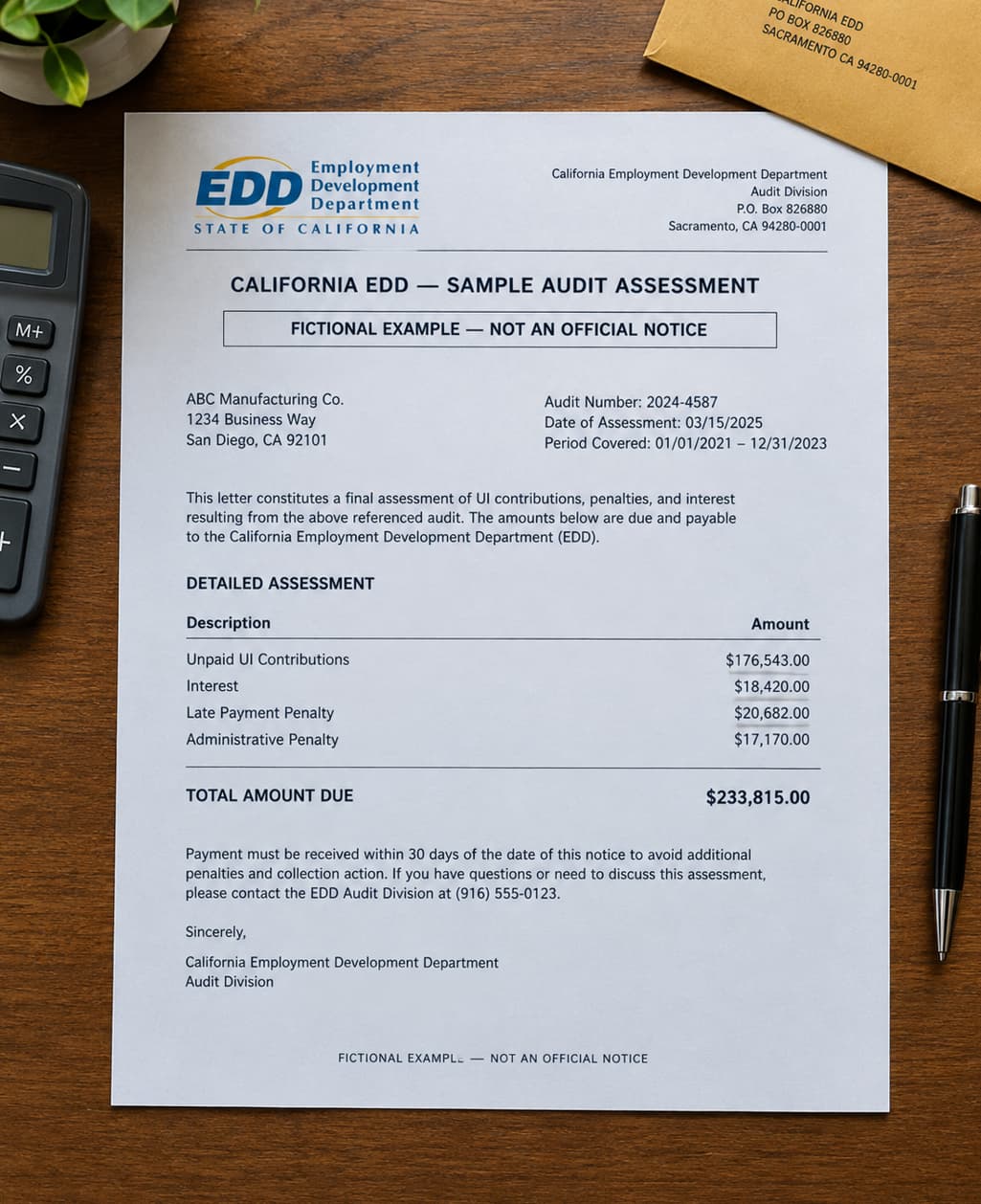
A Small Classification Issue Can Become a Much Larger Financial Problem
Worker classification issues become especially consequential when the same classification was used repeatedly over several years or across a substantial group of workers.
One disputed worker may represent dozens or hundreds of payments. One classification practice may have been applied to several people performing similar work. When the EDD determines that compensation paid to independent contractors should have been treated as employee wages, the resulting exposure can multiply quickly as the agency applies its findings across the audit period.
That is why the real financial question is rarely limited to the amount associated with a single worker or payment. The important question is how broadly the EDD's determination may apply across your business.
The Consequences May Extend Beyond the EDD
An EDD audit does not occur in isolation from the rest of your company's tax and employment obligations. The same underlying facts—who performed services, how those individuals were classified, what they were paid, and how those payments were reported—may also matter to federal taxing authorities and other California agencies.
A worker-classification determination can also raise questions beyond payroll tax reporting. If someone treated as an independent contractor should have been treated as an employee, issues involving wages, benefits and other obligations associated with employment may follow.
This is one reason an EDD matter should not be evaluated solely as a disagreement over a payroll tax assessment. You need to understand what the EDD's findings may mean elsewhere before deciding how the business should respond.
An Assessment Is Not the Time to Discover the Weaknesses in Your Position
By the time an audit produces an adverse determination, the EDD has already reviewed records, evaluated the information provided, considered the relationships and transactions it believes are important, and developed conclusions about what occurred.
That does not necessarily mean those conclusions are correct.
It does mean that challenging them may require more than simply telling the EDD that the business disagrees.
The underlying records, chronology, business relationships, payment history and actual working circumstances must support your position. The earlier those facts are identified and developed, the greater the opportunity to address misunderstandings, provide missing context, challenge unsupported assumptions, and establish an accurate record before the dispute becomes more difficult and expensive to resolve.
The Objective Is to Understand the Full Exposure Before You Decide What to Do
An EDD determination should be evaluated not only for what the agency says is owed, but for what assumptions produced that result, whether those assumptions are supported by the evidence, how broadly the findings have been applied, and what additional consequences may follow.
That requires tax knowledge. It requires an understanding of California employment and worker-classification issues. And when the EDD's conclusions are disputed, it requires the ability to evaluate the matter as a legal controversy rather than simply an accounting problem.
Janathan Allen works with businesses to understand the complete picture: what the EDD has concluded, where the government's position may differ from the underlying facts, what exposure those conclusions may create, and what options remain available to protect the business and challenge an adverse result.

You Need Experienced Tax Counsel When the Stakes Are Significant
 Janathan L. Allen has decades of experience representing businesses, business owners, investors, and individuals in IRS and California tax audits, payroll tax matters, worker misclassification inquiries, reporting issues, collection matters, and complex California tax controversies.
Her experience spans both proactive planning opportunities and high-consequence disputes involving the Internal Revenue Service, the California Franchise Tax Board, the California Department of Tax and Fee Administration, and the Employment Development Department.
Allen Barron also assists clients who are planning ahead, seeking to come into compliance, or addressing international tax concerns before they become larger disputes. Tax planning, voluntary compliance, offshore reporting, expatriate tax issues, international investments, and cross-border business activities often benefit from early, coordinated guidance. Taking the right steps now may help reduce exposure, preserve options, and prevent avoidable tax, legal, accounting, and financial consequences.
The initial consultation is a complimentary, substantive, confidential discussion designed to help you better understand your current position, the issues that may require immediate attention, and the strategies that may help protect your financial and business interests moving forward.
You are invited to engage the chat module on this page, contact Allen Barron, or call (866) 631-3470 to schedule a free, substantive consultation.
Learn more about Janathan L. Allen, APC and Allen Barron’s integrated tax, legal, accounting and business consulting services and how an integrated approach may help identify risk, protect assets, reduce unnecessary exposure, and support your long-term business and financial objectives.