
Welcome. Before You Begin:

Understanding your offshore corporate ownership, U.S. tax obligations, reporting requirements, and related legal and accounting considerations requires focus. We are here to help. As you evaluate the information below, you remain in complete control of your timeline and decisions.
If this material confirms a risk, raises a concern, or if you require immediate clarification, there are multiple ways to easily connect with us for free insight to learn more. You do not need to interrupt your reading or navigate away from this page to secure that guidance:
- Direct Phone Access: Our phone number is anchored in the upper right menu.
- Continuous Chat Support: Actively present on your screen for immediate connection.
- Secure Inquiry: The “Contact Us” menu option above is a direct, private way to connect with us or request a free consultation.
This firm provides a substantive, confidential consultation at no cost. You are invited and encouraged to read the material ahead to orient yourself. When you’re ready to ask questions, or discuss the specific facts of your situation, we invite you to reach out.
Seven Things U.S. Owners with Offshore Business Assets Need to Know

Owning a foreign company or holding offshore business interests can create significant opportunities for international growth, investment, and financial planning. It also creates responsibilities that extend beyond the country where the company is established. For U.S. taxpayers, the legal structure, business operations, financial records, and U.S. tax and reporting obligations must be understood together.
The distinction between foreign financial accounting and U.S. tax treatment is equally important. A transaction may have U.S. tax consequences even when the foreign company's accounting records do not reflect a corresponding gain or loss. Differences in accounting standards, currency treatment, the recognition or classification of transactions, and applicable tax rules may produce results that are not apparent from the foreign financial statements alone. The owner therefore needs to understand not only what the company reports in its books, but how those activities and transactions are treated for U.S. tax purposes.
The most important questions are not simply where the company is incorporated or whether its profits remain overseas. They concern how the company is owned and operated, how income and transactions are treated, what information must be reported, and whether the structure continues to support the owner's business and financial objectives.
The following seven considerations provide a practical framework for understanding offshore corporate ownership and the importance of integrated professional guidance.
1. U.S. Tax Obligations May Arise Before Foreign Profits Are Distributed
A U.S. taxpayer who owns an interest in a foreign company should not assume that U.S. tax obligations arise only when profits are transferred to the United States or distributed to the owner. Depending upon the ownership structure, entity classification, nature of the income, and applicable tax rules, certain foreign earnings may have U.S. tax consequences even when the funds remain within the foreign company.
The existing Controlled Foreign Corporation (CFC), Global Intangible Low-Taxed Income (GILTI), and Passive Foreign Investment Company (PFIC) rules illustrate why the tax treatment of offshore ownership requires careful analysis. These rules address different types of foreign ownership and income, and their application depends upon the specific facts. A foreign company, an investment vehicle, and a related group of operating businesses may present substantially different tax considerations.

The practical question is therefore not simply, “How much money have I brought back to the United States?” It is, “How is my foreign ownership and income treated under U.S. tax law, and what obligations may arise before I receive a distribution?”
2. Reporting Obligations May Exist Even When No Additional U.S. Tax Is Due

A U.S. taxpayer may be required to disclose foreign corporate ownership, financial accounts, assets, or investments even when those interests have produced little or no additional U.S. income tax. Information reporting and the calculation of tax are related, but they are not the same obligation. A foreign company may retain its earnings, an investment may produce no current distribution, or an account may simply hold existing funds, yet separate reporting requirements may still apply.
The existing international reporting framework includes the Foreign Account Tax Compliance Act (FATCA), FBAR reporting, and IRS Forms 5471, 8938, and 8621, among other requirements that may apply depending upon the taxpayer's circumstances. These filings address different types of foreign ownership, financial accounts, assets, and investments. The applicable requirements depend upon factors such as entity classification, ownership and control, the nature of the assets, and the relevant tax year.
For example, certain U.S. persons with interests in foreign corporations may have Form 5471 reporting obligations. Foreign financial accounts may require separate FBAR reporting, while specified foreign financial assets and certain passive foreign investments may involve additional disclosures. These requirements should not be treated as interchangeable, and the absence of additional tax does not necessarily eliminate the obligation to file.
The practical question is therefore not simply, “Did my offshore company make a profit?” It is, “What foreign interests, accounts, assets, and transactions am I required to report, and have those obligations been properly addressed?”
Accurate reporting begins with a clear understanding of the ownership structure and reliable supporting records. When prior filings are incomplete or uncertain, the appropriate first step is to identify the relevant entities, accounts, transactions, and tax years, preserve the available documentation, and obtain advice before selecting a corrective approach. The objective is to understand what was required, what was reported, and what options remain available.
3. The Legal Structure Must Match the Way the Business Actually Operates
A foreign company’s legal structure should reflect how the business is actually owned, managed, financed, and operated. Establishing an entity in another country is only the beginning. The relationships between the owners, the foreign company, any related U.S. or international entities, and the people conducting business on their behalf must be understood as part of the overall structure.
For example, a U.S. owner may establish a foreign subsidiary to serve customers in another market, enter into a joint venture, license intellectual property, or hold an international investment. Each arrangement may involve different ownership rights, management responsibilities, contractual relationships, accounting requirements, and tax considerations. The appropriate structure depends upon the business purpose and the actual activities of the entities involved.
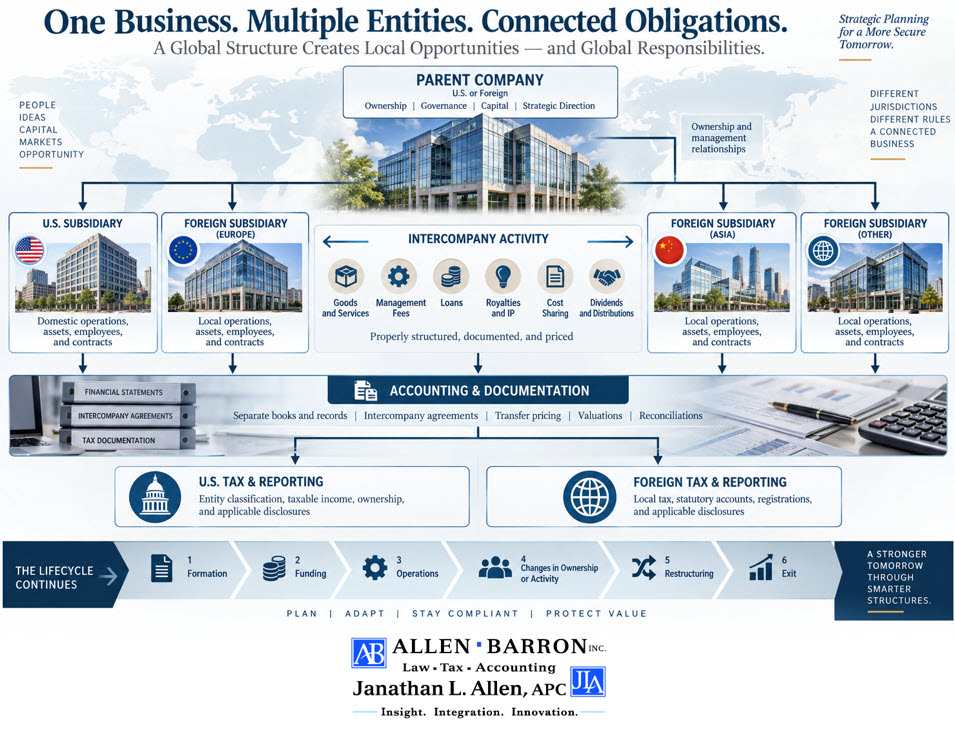
Problems can arise when the organizational documents and agreements describe one arrangement while the business operates in another manner. Management responsibilities may change, employees may begin working in additional jurisdictions, related companies may share expenses or assets, or funds may move between entities without the supporting documentation keeping pace. These developments can affect the legal and tax analysis and make it more difficult to establish a clear picture of the business.
The practical question is therefore not simply, “Where is my offshore company incorporated?” It is, “Does the legal structure accurately reflect who owns, controls, and operates the business, and how its activities and financial relationships are actually conducted?”
A coordinated review by Janathan L. Allen, APC and Allen Barron Inc. can help identify whether the existing structure continues to support the owner’s objectives, whether agreements and records reflect current operations, and whether proposed changes should be evaluated before they are implemented. This is particularly important when establishing additional entities, changing ownership, expanding into new markets, introducing investors, or considering a significant transaction or disposition.
4. Intercompany Transactions Must Be Documented and Supportable
When a U.S. owner controls or holds interests in multiple domestic and foreign companies, transactions between those entities deserve particular attention. Money, property, services, intellectual property, and other assets may legitimately move between related companies, but common ownership does not eliminate the need to establish what each transaction represents and how it should be treated.
Intercompany transactions may include loans and advances, management or professional services, purchases and sales, shared expenses, licensing arrangements, capital contributions, distributions, and transfers of assets. Transfer pricing considerations may also arise when related companies conduct business with one another across international borders. The agreements, pricing, accounting treatment, and actual conduct of the companies should provide a consistent and supportable explanation of these transactions.

This becomes particularly important when money moves between entities. A transfer characterized as a loan should be supported and accounted for as a loan. Payments for services or the use of intellectual property should correspond with the underlying business arrangement. Shared expenses should be identified and allocated appropriately. When the records, agreements, and actual transactions do not agree, determining the appropriate legal, accounting, and tax treatment becomes substantially more difficult.
The practical question is therefore not simply, “Can I move money or assets between companies I own?” It is, “What is the business and legal purpose of the transaction, how should it be documented and accounted for, and what are the U.S. and foreign tax consequences?”
Good intercompany documentation does more than support tax reporting. It helps owners understand the financial relationships between their companies, provides accountants and tax professionals with the information necessary to properly characterize transactions, and establishes a clearer record when those transactions are later reviewed as part of a tax return, audit, restructuring, sale, or other consequential business event.
5. Foreign Financial Records Must Reconcile With U.S. Tax and Reporting Requirements

The financial statements and accounting records of an offshore company tell the story of that business under the accounting standards and requirements that apply where it operates. For a U.S. owner, however, those same records must also provide sufficient information to determine the appropriate U.S. tax treatment and satisfy applicable U.S. reporting requirements.
This is where differences between International Financial Reporting Standards (IFRS), U.S. accounting principles, and U.S. tax rules become important. A transaction that produces one result in the foreign company's financial records may be recognized, classified, measured, or treated differently for U.S. purposes. As a result, a U.S. owner may face a taxable event or reporting obligation even when the foreign company's books do not reflect a corresponding gain or loss.
Allen Barron’s integrated accounting services can help with this specific challenge. However, the challenge extends beyond the accounting standard itself. Foreign currency transactions, intercompany balances, loans and capital contributions, distributions, retained earnings, asset values, expenses, and transactions between related entities all need to be identifiable and supported. Depending upon the circumstances, this may require detailed reconciliations or additional accounting records that allow the foreign company's financial activity to be accurately understood for U.S. tax and reporting purposes.
The practical question is therefore not simply, “Are the foreign company's books accurate?” It is, “Do we have the financial information and supporting records necessary to understand how the company's activities and transactions should be treated and reported in the United States?”
This is one of the primary reasons accounting cannot be separated from legal and tax planning for U.S. owners of offshore companies. When the accounting records, ownership structure, intercompany documentation, and tax reporting tell the same financial story, the owner and their advisors are in a much stronger position to identify obligations, make informed decisions, prepare required filings, and address questions that may arise later.
6. Understand the Facts Before the Next Consequential Decision

International business structures change over time. Companies expand into new markets, ownership interests change, money moves between entities, new investors become involved, assets are acquired or sold, and businesses eventually restructure, wind down, or dispose of foreign interests. Each of these events can change the legal, tax, accounting, or reporting consequences for a U.S. owner.
When questions already exist about the structure or prior reporting, the next transaction can become especially important. A distribution, transfer of an asset, change in ownership, restructuring, sale, or tax filing may establish facts that are difficult to change later. The same is true when an owner discovers incomplete records, an unreported foreign interest, inconsistent intercompany accounting, or a prior filing that may not accurately reflect what occurred.
The first priority should be to understand the facts. Ownership documents, organizational records, prior tax returns and information filings, financial statements, bank and investment records, intercompany agreements, transaction records, and relevant correspondence can help establish what happened, when it happened, and how the companies actually operated.
The practical question is therefore not simply, “What should I do next?” It is, “What do we know, what do the records establish, what obligations may apply, and what options should be evaluated before I take the next consequential step?”
This is particularly important when there may be questions about prior tax or information reporting. The appropriate response should be based upon the actual facts and circumstances rather than assumptions about what went wrong or what must be done to correct it. Establishing the chronology and understanding the available records allows the U.S. owner and their advisors to evaluate the situation before selecting a course of action.
Good planning is not limited to fixing problems. The same discipline applies before establishing another foreign entity, making a substantial distribution, changing ownership, entering a significant transaction, restructuring international operations, or selling or disposing of an offshore business interest. Understanding the consequences before acting helps preserve options that may disappear once the transaction is completed.
7. Integrated Legal, Tax, Accounting, and Business Advisory Services Bring the Structure Together
The first six considerations share one important characteristic: none exists in isolation. A change in ownership may affect tax treatment and reporting. An intercompany transaction may require a legal agreement, appropriate accounting treatment, and tax analysis. A decision to distribute earnings, transfer an asset, license intellectual property, restructure operations, or sell an offshore interest may create consequences across several disciplines at the same time.
This is why our integrated professional services matter to a U.S. owner of an offshore company.
Allen Barron, Inc. and Janathan L. Allen, APC provide integrated legal, tax, accounting, and business advisory services for U.S. taxpayers with international business interests. Instead of requiring the owner to independently coordinate separate attorneys, tax professionals, accountants, and business advisors, the relevant issues can be evaluated together against the same ownership structure, financial records, transactions, objectives, and factual history.
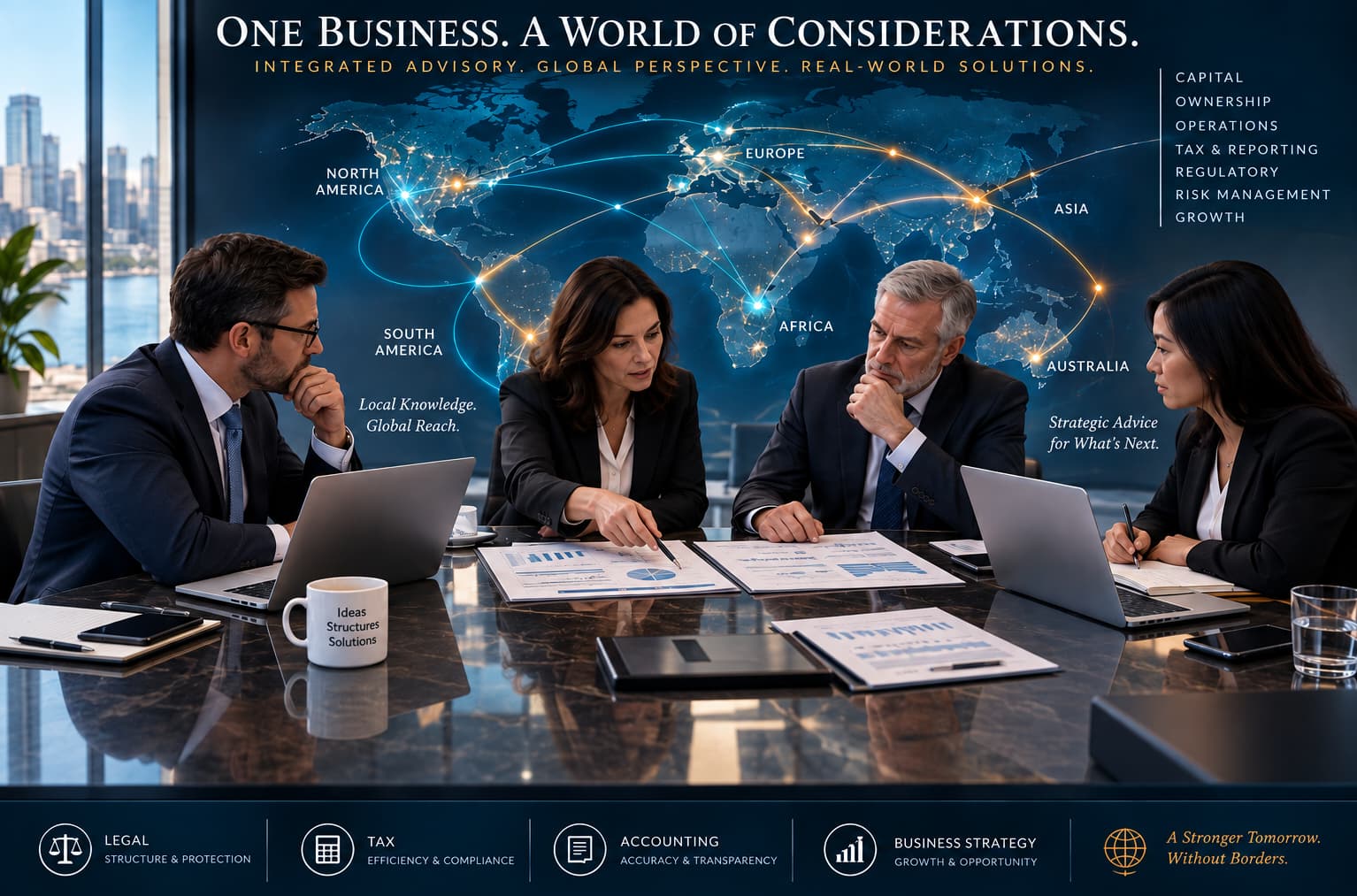
One Decision Can Affect the Entire International Structure
Consider something as straightforward as moving money from a foreign company to its U.S. owner or another related company. Before the transaction is completed, several questions may need to be answered. What does the transfer legally represent? How is it documented? How should it appear in the books of each entity? What is its U.S. tax treatment? Does it affect an information reporting obligation? How does the transaction fit within the owner's larger business and financial objectives?
The same interconnected analysis applies when establishing or acquiring a foreign entity, changing ownership, making an intercompany loan, licensing intellectual property, adding investors, expanding operations, restructuring related companies, or preparing for the sale or disposition of an offshore business interest.
The value of integration is the ability to consider these consequences before one professional decision creates an unexpected problem somewhere else.
The Numbers, Documents, Tax Reporting, and Business Activities Should Tell the Same Story
An offshore company's organizational documents establish important legal relationships. Its contracts and agreements document transactions and responsibilities. Its accounting records show what actually occurred financially. Its U.S. tax returns and international information filings report the resulting activity to tax authorities.
Those records should make sense together.
When they do not, the discrepancy itself may become important. A payment described one way in an agreement but recorded differently in the books may require additional analysis. An intercompany balance that does not reconcile may make it difficult to determine what actually occurred. Foreign financial statements may accurately reflect the applicable accounting treatment abroad while additional analysis is necessary to determine the U.S. tax consequences.
Our integrated services allow the legal documents, accounting records, tax treatment, and actual business operations to be evaluated as parts of the same structure rather than as separate professional assignments.
Integrated Guidance Supports Better Decisions Before and After Problems Arise
U.S. owners do not need integrated guidance only when something has gone wrong. Some of the most valuable work occurs before a consequential decision is made.
Allen Barron and Janathan L. Allen, APC help clients evaluate international corporate ownership and offshore business interests throughout the lifecycle of the investment or enterprise—from formation and planning through ongoing operations, accounting and tax compliance, changes in ownership or structure, and ultimately the sale or disposition of an interest.
When a reporting, accounting, tax, or legal issue has already surfaced, the same integrated approach helps establish the facts, understand the available records, identify the issues that require attention, and evaluate the available options before determining the next course of action.
For a U.S. owner of an offshore company, integration is not simply a matter of convenience. It is how the legal structure, business operations, accounting records, tax treatment, and reporting obligations are brought together into one coherent international business strategy.
You Need Experienced Integrated Legal, Tax, Accounting and Business Advisory Counsel for Offshore Business Owners
 Janathan L. Allen has decades of experience advising businesses, business owners, investors, and individuals regarding complex U.S. and international tax matters. Her work includes international corporate ownership, offshore business interests and investments, international tax planning and reporting, cross-border transactions, and matters involving the Internal Revenue Service and California tax authorities.
Her experience encompasses both proactive planning and situations in which a U.S. taxpayer has discovered a potential tax, accounting, or reporting issue involving foreign ownership or assets. Whether establishing or evaluating an international business structure, managing ongoing U.S. tax and reporting obligations, reviewing prior filings, or preparing for a significant transaction or change in ownership, understanding the complete factual and financial picture is essential before determining the appropriate course of action.
Allen Barron, Inc. and Janathan L. Allen, APC provide an important additional advantage for U.S. owners of offshore companies: integrated legal, tax, accounting, and business advisory services. International corporate ownership frequently requires all four disciplines. The legal structure and agreements, financial records, U.S. tax treatment, international reporting obligations, and actual business operations can be reviewed together rather than as separate professional assignments.
This integrated approach is valuable both when planning ahead and when addressing an existing concern. Establishing the facts, reconciling the financial information, understanding the applicable tax and reporting obligations, and evaluating the owner’s business objectives can help identify available options before consequential decisions are made.
For U.S. owners of offshore companies, experienced international tax counsel provides more than an answer to a tax question. The objective is to understand how the ownership structure, business activities, accounting records, tax consequences, and reporting obligations work together—and to help the owner make informed decisions about what comes next.
The initial consultation is a complimentary, substantive, confidential discussion designed to help you better understand your current position, the issues that may require immediate attention, and the strategies that may help protect your financial and business interests moving forward.
You are invited to engage the chat module on this page, contact Allen Barron, or call (866) 631-3470 to schedule a free, substantive consultation.
Learn more about Janathan L. Allen, APC and Allen Barron’s integrated tax, legal, accounting and business consulting services and how an integrated approach may help identify risk, protect assets, reduce unnecessary exposure, and support your long-term business and financial objectives.