
How Does It Accurately Describe a Problem Business Owners Have Faced for Decades?
Business owners make important decisions every day. Some involve growth. Others involve protecting what has already been built. Purchasing commercial property, admitting a new partner, restructuring ownership, planning for succession, expanding into another state, acquiring part or all of another company, or preparing for the eventual sale of a business all have something in common: they rarely involve only one area of professional expertise.
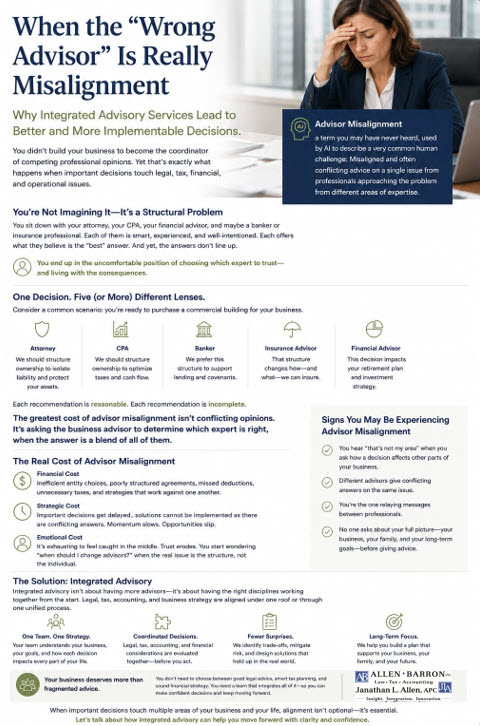
Recently, artificial intelligence began using a phrase that, while unfamiliar to most business owners, actually describes a challenge that has existed for decades: Advisor Misalignment.
It is not a traditional legal term. It is not taught in accounting programs, business schools, or financial planning courses. Rather, it is an AI-generated description of a common business problem: experienced professionals approaching the same decision from different areas of expertise and offering advice that is technically correct from the perspective of their own discipline, but incomplete, and often difficult if not impossible to reconcile into one practical strategy.
The language may be new. The problem is not.
When Every Advisor Has a Piece of the Puzzle Right, but the Decision Becomes More Difficult
Consider a common situation. A successful business owner decides it is finally time to purchase the commercial building the company has leased for years:
- The attorney recommends one ownership structure because it provides stronger liability protection.
- The CPA recommends another because it produces a more favorable tax outcome.
- The lender prefers a different structure that better satisfies underwriting requirements.
- A financial advisor explains how each alternative may affect long-term retirement planning and personal wealth.
- An insurance professional points out that each ownership structure changes available coverage, exclusions, and risk exposure.
Every recommendation is reasonable. Every recommendation reflects years of professional experience. Every recommendation is intended to protect the client. Yet after meeting with each advisor, even groups of advisors, the business owner often feels less certain than before seeking professional guidance.
The reason is straightforward: Each advisor is viewing the same decision through a different professional lens. Each is attempting to optimize a different part of the same business decision.
The Business Owner Quietly Becomes the Coordinator
This is where Advisor Misalignment begins.
It does not necessarily mean anyone is incompetent. It does not suggest poor advice has been given. More often, it reflects the natural result of professional specialization:
- Attorneys are trained to evaluate legal exposure.
- CPAs focus on taxation, compliance, and financial reporting.
- Financial advisors concentrate on investment strategy and long-term wealth management.
- Bankers evaluate lending risk.
- Insurance professionals analyze exposure and coverage.
Each discipline brings valuable experience to the discussion.
The difficulty arises because significant business decisions rarely remain within a single discipline.
Without intending to, the business owner becomes responsible for coordinating legal advice, tax planning, accounting, financing, insurance, and business strategy. The owner is expected to determine how all of those recommendations fit together, even though none of the advisors is evaluating the complete picture independently.
That responsibility was never meant to belong to the client. This is the value Allen Barron contributes to our clients: Integrated Advisory Services.
The Real Cost Is Not Conflicting Opinions
Many business owners assume the greatest risk is receiving conflicting advice.
In reality, the greater challenge is not only the inability to reach an implementable solution, but the loss of valuable time, money and resources.
The greatest cost of “Advisor Misalignment” is not conflicting opinions. It is asking the business owner to determine which component of each expert is right when the best solution is often a thoughtful combination of every discipline involved.
Rather than approaching legal, tax, accounting, and business issues as separate engagements, Allen Barron integrates these professional disciplines into a coordinated advisory process. Attorneys, tax professionals, accountants, and business advisors evaluate significant decisions from their respective areas of expertise, identifying how legal obligations, tax consequences, financial reporting, operational objectives, and long-term business goals influence one another.
This collaborative Allen Barron approach helps uncover potential conflicts, evaluate practical alternatives, and develop recommendations that are legally sound, tax-efficient, financially informed, and operationally realistic. The objective is not simply to provide multiple professional opinions, but to blend the experience and perspective of each discipline into a coordinated strategy that business owners can implement with confidence.
Business owners should not have to choose between liability protection and tax efficiency. They should not have to decide whether succession planning is more important than preserving cash flow, or whether financing requirements should outweigh operational flexibility.
These issues are interconnected.
Treating them as separate decisions frequently delays implementation, increases cost, and causes opportunities to pass while everyone waits for clarity. Important projects are postponed, transactions become more expensive than necessary, and strategic momentum is lost—not because expertise is lacking, but because expertise has become fragmented.
Why This Challenge Continues to Grow
Professional specialization has created tremendous value for businesses.
Today’s attorneys, accountants, tax professionals, financial advisors, and consultants possess a depth of knowledge that would have been difficult to imagine a generation ago.
That specialization benefits clients every day. At the same time, modern business decisions have become increasingly interconnected:
- A legal decision creates tax consequences.
- Tax planning influences cash flow.
- Cash flow affects financing.
- Financing decisions influence business growth.
- Growth eventually impacts succession planning, estate planning, and long-term wealth preservation.
Everything connects. Everything Intersects.
Unfortunately, many advisory relationships remain structured as though these decisions occur independently of one another.
They do not.
Why Allen Barron’s Integrated Advisory Services Represent a Different Approach
Rather than asking business owners to coordinate multiple professionals on their own, Allen Barron’s Integrated Advisory Services begin with a different assumption: the most important business decisions should be evaluated from multiple professional perspectives, and integrated into implementable options before recommendations are presented to the client.
Legal considerations should be examined alongside tax consequences. Accounting implications should be evaluated together with operational objectives. Business strategy, ownership structure, financing, and long-term planning should be considered as parts of the same conversation rather than separate engagements occurring weeks or months apart.
This approach does not diminish the value of professional specialization. It strengthens it.
Instead of working in isolation, experienced professionals contribute their knowledge as part of a coordinated strategy designed to help clients understand both the opportunities and the consequences before important decisions are made.
The result is not simply more advice. It is advice that works together to develop and implement the right solution to the challenge(s) at hand.
Better Decisions Are Decisions That Can Be Implemented
The purpose of Allen Barron’s Integrated Advisory Services is not to generate longer reports or more technical analysis.
The purpose is to help business owners make informed decisions that can be implemented with confidence because legal, tax, accounting, and business considerations have already been evaluated together.
Business owners deserve more than isolated opinions. They deserve practical guidance that reflects how businesses actually operate and how important decisions affect every aspect of the organization—not just one professional discipline.
“Advisor Misalignment” may be a new phrase introduced through artificial intelligence, but it accurately describes a challenge business owners have quietly navigated for many years.
The solution is not necessarily finding another attorney, another CPA, or another financial advisor.
The best solution is changing the way professional advice is delivered.
Allen Barron’s Integrated Advisory Services replace fragmented recommendations with coordinated thinking, allowing business owners to move forward with greater understanding, greater confidence, and an implementable strategy designed to accomplish the objective(s) on the table, answer the question(s) at hand, and support the success of the business as a whole.
We invite you to learn more about the “Integrated Advisory Services” and the tax, legal, accounting and business consulting services of Allen Barron, and contact us or call today to schedule a free consultation at 866-631-3470.