
Welcome. Before You Begin:

Understanding FBAR preparation and filing requirements are important for a U.S. taxpayer with offshore financial accounts or assets. We are here to help. As you evaluate the information below, you remain in complete control of your timeline and decisions.
If this material confirms a risk, raises a concern, or if you require immediate clarification, there are multiple ways to easily connect with us for free insight to learn more. You do not need to interrupt your reading or navigate away from this page to secure that guidance:
- Direct Phone Access: Our phone number is anchored in the upper right menu.
- Continuous Chat Support: Actively present on your screen for immediate connection.
- Secure Inquiry: The “Contact Us” menu option above is a direct, private way to connect with us or request a free consultation.
This firm provides a substantive, confidential consultation at no cost. You are invited and encouraged to read the material ahead to orient yourself. When you’re ready to ask questions, or discuss the specific facts of your situation, we invite you to reach out.
I Have Accounts or Assets Overseas. Do I Have to File an FBAR?

If you are a U.S. person with a financial interest in, or signature authority over, foreign financial accounts, you may be required to file an FBAR. The requirement may apply even when no additional U.S. tax is owed and even when the accounts produce little or no income.
In general, FBAR reporting should be considered whenever the combined value of your foreign financial accounts exceeds $10,000 at any point during the calendar year, even for a single day in that year.
Foreign bank accounts, investment accounts, certain retirement accounts, business accounts, and other foreign financial accounts may create FBAR reporting obligations. Simply owning an asset outside the United States does not necessarily mean it must be reported on an FBAR. The first question is whether your foreign assets include financial accounts subject to FBAR reporting requirements.
Many people discover potential FBAR obligations only after accepting a job overseas, retaining accounts in another country, inheriting foreign assets, acquiring an interest in a foreign business, preparing a tax return, or discussing their international financial interests with a tax professional.
Who Needs to Consider FBAR Reporting?
FBAR reporting requirements can affect U.S. citizens, green card holders, dual citizens, expatriates, foreign nationals who have become U.S. tax residents, businesses, trusts, and other U.S. persons with foreign financial accounts. Business owners with foreign operations and executives with signature authority over international accounts may also have reporting obligations.
For some taxpayers, the issue begins with something that seemed completely routine. You may have kept a bank account in your country of origin after moving to the United States. You may maintain local accounts while living or working overseas. You may have inherited financial accounts from a parent or relative or acquired an ownership interest in a foreign business or investment account.
In many cases, the concern is not whether taxes were paid. The issue is whether required foreign account reporting obligations were satisfied.
If you are uncertain whether an FBAR was required, the first step is to identify the foreign financial accounts involved, your ownership interest or authority over those accounts, their value during the applicable year, and your prior filing history.
Allen Barron assists individuals, business owners, expatriates, dual citizens, and taxpayers with international financial interests in evaluating FBAR reporting requirements, addressing missed filings, and identifying appropriate options for compliance with U.S. foreign account reporting laws.
Where Are You, and What Is the Next Step?
Foreign account reporting issues arise in many different ways. Some taxpayers maintain foreign bank or investment accounts. Others live abroad, inherit overseas assets, own foreign businesses, discover reporting obligations years later, or receive correspondence from the IRS regarding international reporting matters. Identify the situation that most closely reflects your circumstances to better understand common issues, potential reporting obligations, and available next steps.








I Have Foreign Bank, Investment, or Cryptocurrency Accounts
If you maintain financial accounts outside the United States, the first issue is identifying exactly what you have and how those accounts relate to U.S. foreign account reporting requirements. The analysis is not limited to whether an account produced income or resulted in additional U.S. tax.
Foreign bank accounts, investment accounts, certain retirement accounts, joint accounts, business accounts, and some financial relationships involving cryptocurrency or digital assets may require different reporting analysis. The important first step is to identify each account, your relationship to it, and its value during the applicable calendar year.
That review should include accounts you own directly as well as accounts you own jointly or over which you may have signature or other authority. It should also consider whether the combined value of reportable foreign financial accounts crossed the applicable FBAR reporting threshold during the year.
Current and Prior-Year Reporting May Need to Be Reviewed
If the accounts have existed for more than one year, the question may extend beyond the current filing period. Account ownership, balances, prior FBAR filings, tax returns, and other international reporting should be reviewed together to determine what was reported, what may have been omitted, and which years may require attention.
The objective is to establish the facts before deciding what, if anything, needs to be corrected.
Living Outside the United States and FBAR Reporting Requirements
Living outside the United States can make foreign financial accounts feel entirely domestic. A checking account used to pay rent, a local savings account, an employer-related retirement account, or an investment account established where you live may simply be part of everyday financial life.
For a U.S. citizen, dual citizen, lawful permanent resident, or other person subject to applicable U.S. reporting requirements, however, living abroad does not by itself determine whether those accounts must be reported.
The important question is not whether an account feels “foreign” to you. The question is whether your U.S. status and your financial interest in or authority over the account create a reporting obligation.
Start With the Accounts That Are Part of Your Life Abroad
Identify the bank, investment, retirement, and other financial accounts you maintain in your country of residence and elsewhere. Determine who owns each account, whether anyone else shares ownership, whether you have authority over accounts you do not own, and the maximum values involved during the applicable year.
If you have lived abroad for several years, prior-year reporting should also be reviewed. The goal is to determine whether required filings were made consistently and whether other international reporting requirements may overlap with your FBAR obligations.
Inherited Foreign Accounts or Assets and FBAR Reporting Requirements
An inheritance involving property or financial interests outside the United States can create several different questions, and it is important not to treat every inherited foreign asset as though it were automatically an FBAR-reportable account.
The first task is to determine exactly what you inherited. A foreign bank or investment account presents different reporting questions from foreign real estate or another non-account asset. A foreign trust, estate structure, retirement account, or business interest may involve additional reporting considerations.
The fact that an inheritance is located overseas is only the beginning of the analysis. What you inherited, when your interest arose, and what ownership or authority you acquired are what need to be established.
Determine What Changed When You Inherited the Assets
Review the estate or inheritance documents and identify any foreign financial accounts, investments, retirement interests, trusts, business interests, or other assets involved.
It may also be necessary to determine whether assets have already been distributed, whether they remain within an estate or trust, whether ownership is shared with other beneficiaries, and when you acquired ownership or authority over any financial accounts.
Those distinctions can affect which reporting requirements should be evaluated and when those requirements may have begun.
Foreign Business Ownership and International Reporting Requirements
Owning or participating in a business outside the United States can create reporting questions at both the individual and business level. The analysis may involve more than your percentage of ownership in the company.
A foreign business may maintain bank, investment, operating, or other financial accounts. You may own an interest in those accounts through the business, have signature or transactional authority over them, or have other international reporting requirements associated with the underlying entity.
Foreign business ownership and authority over foreign business accounts should be examined together rather than assuming the company's local filings satisfy your U.S. reporting obligations.
Identify Your Ownership, Authority, and the Accounts Involved
Begin with the structure of the foreign business: what type of entity it is, where it operates, who owns it, your ownership interest, and the authority you exercise.
Then identify the company's foreign financial accounts and determine which accounts you can access, control, authorize transactions from, or sign on behalf of the business.
International business ownership can involve reporting requirements beyond the FBAR. Understanding the entity structure and financial relationships helps determine which obligations should be evaluated together.
Recently Learning About FBAR Requirements
Discovering FBAR requirements after maintaining foreign accounts for years can immediately raise questions about what should have been filed and what may have happened in prior years.
Learning about an FBAR requirement today does not, by itself, tell you whether you were required to file one in every prior year or what should happen next. The facts need to be established first.
The starting point is determining when the accounts existed, your relationship to them, their values during the relevant years, and what information was included in prior U.S. filings.
Do Not Start With an Assumption About What Happened
You may have learned about FBAR from a CPA, financial advisor, online research, or a conversation concerning your foreign accounts. That discovery is a reason to review your history, not a substitute for reviewing it.
Identify the accounts involved and determine when each was opened or acquired. Gather prior FBARs, if any, along with tax returns and available account records. Determine what you knew about the accounts and reporting requirements during the relevant periods.
That information allows the actual scope of any potential reporting issue to be evaluated.
Missed FBAR Filings and Compliance Options
If you believe an FBAR should have been filed in one or more prior years, the most useful first step is not to assume why the filing was missed or which compliance procedure should be used.
The circumstances matter. The accounts involved, years affected, balances, ownership or signature authority, information reported elsewhere on U.S. tax filings, and circumstances surrounding the missed filings all need to be understood.
A missed FBAR should be evaluated based upon what actually occurred, not immediately characterized as fraud, tax evasion, willfulness, or an innocent mistake before the relevant facts are known.
Establish the Prior-Year Record Before Choosing a Compliance Path
Identify each potentially reportable account and the years during which you had a financial interest in or authority over it. Determine the maximum account values for those years and gather any FBARs, tax returns, account statements, correspondence, and professional advice relating to the accounts.
The review should also determine whether other international reporting issues overlap with the missing FBARs.
Once the history is established, the available compliance options can be evaluated in light of your specific circumstances rather than selected prematurely.
IRS Foreign Account Notices and Compliance Matters
Once you receive correspondence from the IRS concerning foreign accounts, international reporting, or prior filings, the situation changes. There is now a specific government communication that needs to be understood in the context of your reporting history.
The first priority is to determine exactly what the IRS sent, what it is asking for, which tax years or accounts are involved, and whether the correspondence establishes a deadline for responding.
Do not assume that the notice means the IRS has already concluded that wrongdoing occurred. At the same time, do not treat the correspondence as a generic request without first understanding its scope.
Review the Notice Before Deciding How to Respond
Preserve the complete notice, including every page and enclosure. Identify the date, response deadline, tax periods, forms, accounts, and specific information referenced.
Then compare the notice with your prior FBARs, U.S. tax returns, international information returns, account statements, and other relevant records.
That review can help establish what information the government appears to have, what information it is requesting, and whether there are discrepancies or unanswered questions that should be addressed before a response is prepared.
Bringing Your Foreign Accounts Into Compliance
You may not have received an IRS notice or encountered an enforcement action. You may simply have discovered that foreign account reporting requirements could apply to you and want to determine whether past filings need attention and how reporting should be handled going forward.
That is a different starting point from responding to government contact. It provides an opportunity to assemble the facts, understand the reporting history, and evaluate available compliance options deliberately.
The goal is not simply to file something. The goal is to understand what was required, what was previously reported, what may need to be addressed, and how future reporting should be handled correctly.
Build a Complete Picture Before Selecting the Process
Identify your foreign financial accounts, ownership interests, signature authority, relevant account values, and the years involved. Compare that information with prior FBARs, tax returns, and other international filings.
If something appears to have been omitted or reported incorrectly, the circumstances surrounding the prior filings should be evaluated before deciding how to address them.
The appropriate path depends upon the facts. A deliberate review helps distinguish current filing needs from prior-year corrective issues and other international reporting obligations that may also require attention.
The Most Important Thing You Need to Know About FBAR Compliance

Many taxpayers discover potential FBAR reporting obligations years after opening a foreign account, inheriting financial interests overseas, moving to or from another country, or acquiring an interest in a foreign business. In many cases, the reporting requirement was simply unknown.
The most important thing is to understand exactly what happened before deciding how to address it.
If you believe an FBAR should have been filed, begin by establishing the facts. Identify the foreign financial accounts involved, your ownership or authority over those accounts, the years involved, their values during those years, and what was reported on prior FBARs, tax returns, and other international filings.
Do Not Assume You Know the Extent of the Problem
Discovering a foreign account reporting issue does not, by itself, establish how many years are affected, whether every account was reportable, whether other international reporting requirements apply, or which compliance option is appropriate.
The reporting history needs to be reconstructed before those questions can be answered.
Do Not Choose a Compliance Strategy Before Establishing the Facts
Different circumstances may require different approaches. A taxpayer who recently discovered a reporting obligation may be in a very different position from someone who has already received government correspondence regarding foreign accounts.
The appropriate path should follow the facts and filing history—not assumptions about what the problem is or how it should be corrected.
Preserve the Information You May Need
Foreign account statements, prior FBARs, tax returns, international information returns, ownership records, correspondence, and information concerning when accounts were opened, acquired, transferred, or closed may become important in understanding the reporting history.
Gathering and preserving that information helps establish what occurred and what information may still be missing.
Address the Issue Deliberately Rather Than Ignoring It
Once a potential reporting problem has been identified, leaving it unresolved does not provide greater clarity. The productive next step is to determine whether a reporting obligation existed, understand the scope of any prior-year issue, and evaluate the available options based upon your actual circumstances.
Understanding where you stand before taking corrective action helps preserve your ability to make informed decisions about what happens next.
We invite you to learn more about the integrated services of Allen Barron and Janathan L. Allen APC, and how we can help you to resolve these challenges. You can connect with the chat button on your screen, contact us or call today to schedule a free consultation at 866-631-3470.
Understanding FBAR Reporting Requirements
FBAR requirements are based upon several related questions: who is subject to the reporting requirement, what foreign financial accounts are involved, what financial interest or authority the person has over those accounts, and whether the combined value of the reportable accounts exceeds the applicable reporting threshold.
What Is an FBAR?
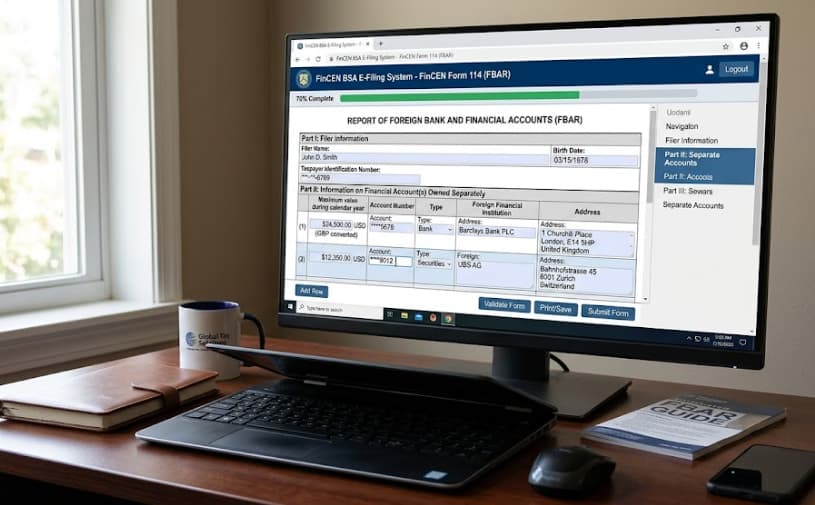
An FBAR, or Report of Foreign Bank and Financial Accounts, is an annual report concerning certain foreign financial accounts held by or under the authority of U.S. persons. The FBAR is filed with the U.S. Treasury Department and is separate from a federal income tax return.
An FBAR is an information-reporting requirement. A filing obligation may therefore exist even when the foreign accounts generate little or no income and no additional U.S. tax is owed.
This distinction is one reason taxpayers sometimes discover an FBAR issue even though they believe their income tax returns and tax payments have been handled correctly.
Who Must File an FBAR?

FBAR reporting generally applies when a U.S. person has a financial interest in, or signature or other authority over, reportable foreign financial accounts and the aggregate value of those accounts exceeds $10,000 at any time during the calendar year—even for a single day.
U.S. persons who may encounter FBAR reporting requirements include:
- U.S. citizens
- U.S. residents
- Certain domestic businesses and other entities
- Trusts and estates
- Individuals who own or jointly own foreign financial accounts
- Individuals with signature or other authority over foreign financial accounts
The threshold applies to the combined value of reportable foreign financial accounts, rather than separately to each account. As a result, several accounts individually valued below $10,000 may still create an FBAR filing requirement when their aggregate value exceeds the threshold.
What Foreign Financial Accounts May Be Reportable?

The definition of a foreign financial account is broader than many taxpayers initially expect. Depending upon the circumstances, accounts that may require consideration include:
- Foreign bank accounts
- Foreign brokerage accounts
- Foreign investment accounts
- Certain foreign retirement and pension accounts
- Certain foreign insurance or annuity products with cash value
- Joint foreign financial accounts
- Foreign business accounts
- Accounts over which a person has signature or other authority
Not every asset located outside the United States is necessarily an FBAR-reportable financial account. Foreign real estate, business ownership, trusts, inherited assets, and other international financial interests may raise different or additional U.S. reporting questions.
Determining whether an FBAR is required therefore involves more than identifying whether you have assets outside the United States. The analysis begins with identifying the accounts involved, determining your ownership or authority over them, establishing their values during the applicable year, and reviewing what has previously been reported.
Why Experience Matters in FBAR Preparation and Compliance

Why Experience Matters in FBAR Preparation and Compliance
FBAR compliance issues often appear deceptively simple. A taxpayer may believe the question is merely whether a foreign account should have been reported. In reality, many FBAR matters involve a broader analysis of account ownership, signature authority, aggregate account balance analysis, reporting thresholds, international tax filings, prior-year compliance history, and the circumstances surrounding any missing or incomplete disclosures.
Did the aggregate value of all foreign accounts exceed reporting thresholds at any point during the year, even for a single day?
Many taxpayers are surprised to learn that FBAR reporting is not filed with the IRS. Instead, FBAR disclosures are submitted to the Financial Crimes Enforcement Network (FinCEN).
The IRS maintains separate international reporting requirements that may apply to foreign financial assets and offshore accounts. In some situations, a taxpayer may be required to file both an FBAR and additional IRS reporting forms. Because reporting thresholds, filing requirements, and definitions differ, international compliance issues can become more complex than many individuals initially realize. A taxpayer may satisfy one reporting obligation while overlooking another. What appears to be a relatively modest foreign account balance or ordinary overseas financial relationship may nevertheless create multiple reporting obligations under U.S. law.
Foreign account reporting obligations frequently intersect with other international reporting requirements. A taxpayer may have FBAR filing obligations, foreign asset disclosures, international information returns, foreign business reporting requirements, or international tax issues that must be evaluated together rather than in isolation. What initially appears to be a single filing question can quickly become a much broader compliance matter.
Experience matters because FBAR compliance requires more than preparing and filing forms. It requires understanding how international reporting rules interact, recognizing potential compliance risks, evaluating available options when prior filings have been missed, and helping taxpayers make informed decisions before unnecessary penalties or complications arise. Early decisions often influence the options available later.
International Investments, Accounts, Real Estate, and Business Interests Require Expert Insight from Multiple Disciplines
 The value of integrated tax, legal, accounting, and business advisory services cannot be overstated for individuals and businesses with foreign accounts, offshore assets, international investments, and cross-border business interests.
International reporting and compliance issues rarely exist within a single professional discipline. A decision that appears appropriate from a legal perspective may create unintended tax consequences.
A tax-driven strategy may create accounting complications. A business decision may trigger reporting obligations that were never anticipated. When multiple advisors operate independently, each may provide sound advice within their area of expertise while no one evaluates the full picture.
That is one of the reasons clients value the integrated structure of Allen Barron, Inc. and Janathan L. Allen, APC. Rather than coordinating separate conversations among multiple professionals, clients gain access to a team capable of evaluating legal, tax, accounting, financial, and business considerations together. The result is often greater clarity, better decision-making, reduced risk, improved efficiency, and opportunities that might otherwise be overlooked.
For many clients, the ability to have a single conversation with Janathan Allen and the Allen Barron team provides meaningful value in itself. Complex international reporting matters become easier to understand, options become easier to evaluate, and decisions can be made with a clearer understanding of the consequences across all aspects of the client’s financial and business life.
International reporting obligations frequently extend beyond a single filing requirement. They often involve overlapping tax, legal, accounting, financial, and business considerations that must be evaluated together. This is one of the reasons integrated professional guidance can be particularly valuable in complex FBAR and international compliance matters.
We invite you to access our chat module, Schedule Your Complimentary Assessment, or call (866) 631-3470 to begin the process of understanding the complex financial, reporting, legal, and tax issues presented, evaluating available options, and protecting your personal, business, legal, and financial interests.
Why Integrated Legal, Tax, and Accounting Matters

Many international tax and reporting issues are not isolated problems. They often involve overlapping legal, tax, accounting, reporting, financial, and business considerations that affect one another in important ways.
A foreign account may trigger multiple reporting obligations.
An international investment may create tax and compliance consequences.
A foreign business interest may affect reporting requirements, ownership structure, and long-term planning.
A legal decision may materially impact taxation, asset protection, reporting obligations, or future business objectives.
The challenge is that many professionals evaluate these issues from only one perspective.
An integrated approach helps identify not only the immediate issue, but the underlying legal, tax, accounting, reporting, financial, and business considerations that may ultimately shape the outcome moving forward.
That integration has long been one of the defining advantages of Allen Barron’s approach to complex international tax, legal, accounting, financial, and business matters.
Many international reporting and compliance concerns initially appear to be isolated issues. In reality, they are often symptoms of a larger underlying challenge.
The old expression, “where there’s smoke, there’s fire,” frequently applies.
A taxpayer may believe they simply need assistance with an FBAR filing, foreign asset disclosure, international investment, foreign business interest, or IRS reporting issue. As the situation is examined more closely, other legal, tax, accounting, reporting, operational, and strategic considerations often emerge beneath the surface.
An integrated approach helps identify not only the visible issue, but the underlying factors that may ultimately determine risk, opportunity, compliance, and long-term outcomes moving forward.

You Need an Advisor You Can Trust — A Single Phone Call to Make When Challenges and Opportunities Arise
International reporting obligations, foreign accounts, offshore investments, cross-border business interests, and international tax matters often create questions that extend beyond a single form, filing requirement, or tax return. The challenge is rarely finding information. The challenge is understanding how legal, tax, accounting, reporting, financial, and business considerations interact and what actions make sense moving forward.
Janathan L. Allen and the team at Allen Barron provide integrated legal, tax, accounting, and business advisory services designed to help individuals, investors, business owners, expatriates, and international taxpayers navigate complex financial and reporting matters with greater clarity and confidence.
Whether you are attempting to understand FBAR requirements, address prior-year compliance concerns, evaluate international reporting obligations, respond to government inquiries, structure an international investment, or simply gain confidence that your reporting obligations have been addressed properly, experienced guidance can help you better understand your options before important decisions are made.
The initial consultation is a substantive, confidential discussion designed to help you understand your current situation, identify potential risks and opportunities, evaluate available options, and determine appropriate next steps.
You are invited to engage the chat module on this page, contact Allen Barron, or call (866) 631-3470 to schedule your complimentary consultation.
Learn more about Janathan L. Allen, APC and Allen Barron’s integrated legal, tax, accounting, and business advisory services and how an integrated approach may help identify opportunities, reduce unnecessary risk, protect assets, and support your long-term financial and business objectives.
Learn more about Janathan L. Allen, APC and Allen Barron’s integrated tax, legal, accounting and business consulting services and how an integrated approach may help identify risk, protect assets, reduce unnecessary exposure, and support your long-term business and financial objectives.